• Skip to primary navigation
  • Skip to main content
  • Skip to footer

LKT Labs

Biochemicals for Life Science Research

  • Products
    • New Products
    • Cancer Biology
    • Cardiovascular
    • Endocrine Signaling and Immunology
    • Metabolic and GI Pathology
    • Microbiology
    • Natural Products
    • Neuroscience
    • Peptides
    • Pharmaceutical Impurities and Derivatives
    • Stem Cell Modulators
  • Services
    • Custom Synthesis
    • Natural Product Isolation
    • Analytical Services
  • Int’l Distributors
  • Support
    • About LKT Labs
    • General Inquiry
    • Bulk Quote Request
    • Document Request
    • Technical Support
    • Catalog Request
    • Product Flyers
  • Contact Us
  • Cart
  • Login / Register
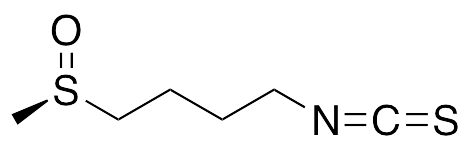
R-Sulforaphane, synthetic

R-Sulforaphane, synthetic

Product ID S8051
Cas No. 142825-10-3
Purity ≥98%
Product Unit SizeCostQuantityStock
50 mg $386.00 Please Inquire
100 mg $551.00 Please Inquire
250 mg $1,081.00 Please Inquire
500 mg $1,985.00 Please Inquire
Bulk Quote

Quicklinks

  • Description
  • Product Info
  • Shipping and Storage
  • Downloads
  • References
  • Description
  • Product Info
  • Shipping and Storage
  • Downloads
  • References
  • Custom Order

Description

R-Sulforaphane Synthetic is the synthetic version of R-sulforaphane.
R-Sulforaphane is a naturally-occurring isothiocyanate found in broccoli. This compound exhibits antioxidative, anticancer, and chemopreventive activities; research suggests that it may be more bioactive than the S-isomer. R-Sulforaphane increases expression of phase II enzymes such as glutathione-S-transferase and quinone reductase; it also increases activity and expression of glucuronosyl transferase and epoxide hydrolase. At low doses, R-sulforaphane promotes proliferation of stem cells and hematopoiesis. This compound also inhibits the aryl hydrocarbon receptor.

Please note: This compound is a neat liquid at room temperature, clear to slightly yellow in color. It is not dissolved in solvent. In small quantities the material will coat the sides of the ampule it is shipped in and may appear to be invisible, or it may be trapped in the tip of the ampoule. Wash the upper and lower parts of the ampoule with solvent to ensure all of the material is obtained.

Product Info

Cas No.

142825-10-3

Purity

≥98%

Formula

C6H11NOS2

Formula Wt.

177.29

Chemical Name

1-Isothiocyanato-4-(methylsulfinyl)-butane, synthetic

IUPAC Name

1-isothiocyanato-4-[(R)-methylsulfinyl]butane

Synonym

L-Sulforaphane synthetic

Solubility

Soluble in ethanol, methanol, or ethyl acetate. Miscible with water and/or DMSO.

Appearance

Very slight yellowish liquid

Shipping and Storage

Store Temp

-20°C

Ship Temp

Ambient

Downloads

Info Sheet

S8051 Info Sheet PDF

References

Abdull Razis AF, Hanlon N, Soltys E, et al. The naturally occurring aliphatic isothiocyanates sulforaphane and erucin are weak agonists but potent non-competitive antagonists of the aryl hydrocarbon receptor. Arch Toxicol. 2012 Oct;86(10):1505-14. PMID: 22643862.

Zanichelli F, Capasso S, Cipollaro M, et al. Dose-dependent effects of R-sulforaphane isothiocyanate on the biology of human mesenchymal stem cells, at dietary amounts, it promotes cell proliferation and reduces senescence and apoptosis, while at anti-cancer drug doses, it has a cytotoxic effect. Age (Dordr). 2012 Apr;34(2):281-93. PMID: 21465338.

Abdull Razis AF, Bagatta M, De Nicola GR, et al. Induction of epoxide hydrolase and glucuronosyl transferase by isothiocyanates and intact glucosinolates in precision-cut rat liver slices: importance of side-chain substituent and chirality. Arch Toxicol. 2011 Aug;85(8):919-27. PMID: 21132492.

Abdull Razis AF, Iori R, Ioannides C. The natural chemopreventive phytochemical R-sulforaphane is a far more potent inducer of the carcinogen-detoxifying enzyme systems in rat liver and lung than the S-isomer. Int J Cancer. 2011 Jun 15;128(12):2775-82. PMID: 20726001.

Christine A. Houghton, Sulforaphane: Its “Coming of Age” as a Clinically Relevant Nutraceutical in the Prevention and Treatment of Chronic Disease. Oxidative Medicine and Cellular Longevity Volume 2019, Article ID 2716870, 27 pages https://doi.org/10.1155/2019/2716870

Custom Order

  • Size of single unit expressed as number (e.g. '500' in the case of 500 mg)
  • Total quantity of unit size desired (e.g. '10' in the case of 10 x 500 mg). If only one unit is desired, you may leave this blank.
  • This field is for validation purposes and should be left unchanged.

Related Products

  • M1779

    Methyldopa Sesquihydrate

    DOPA decarboxylase inhibitor, indirect α2-adre...

    ≥98%
  • T5871

    Torin 2

    Tricyclic benzonaphthyridinone; mTORC1/2 inhibi...

    ≥98%
  • T3099

    Thymus Factor

    Endogenous peptide, involved in immune signalin...

    ≥95%
  • F8048

    Fumagillin

    Produced by Aspergillus; type 2 methionine amin...

    ≥98%
  • H3277

    Histrelin Acetate

    Peptide, GnRH analog; GnRH agonist.
    ≥95%
  • SB5778

    Snake venom – Bothrops neuwiedi diporous

    Snake venom found in Bothrops neuwiedi diporus;...

    ≥98%
  • A5056

    Amorolfine Hydrochloride

    14α-demethylase inhibitor.

    ≥98.5%
  • S8098

    SU-1498

    Tyrphostin; VEGFR inhibitor.

    ≥99%
  • V5870

    Vortioxetine

    5-HT1A agonist, 5-HT1B partial agonist, 5-HT3A/...

    ≥99%
  • A0534

    Abiraterone

    Progesterone derivative; Cyp17A1 inhibitor.

    ≥99%
  • I4800

    Imatinib free base

    Inhibitor of Abl, c-Kit, and PDGFR.

    ≥99%
  • C4417

    Clemizole

    TRPC5 activator, NS4B and histamine H1 inhibito...

    ≥98%
  • C5782

    Coumarin

    Benzopyrone found in various plants, precursor ...

    ≥98%
  • L930280

    LXH254

    pan-RAF inhibitor

    ≥99%
  • L186858

    Levomefolic acid

    Folic acid derivative

    ≥98%
  • N0262

    Naphazoline Hydrochloride

    α1-adrenergic agonist.

    ≥97%
  • A7202

    AS-604850

    p110γ PI3K inhibitor.

    ≥98%
  • C864760

    CVT-313

    Selective CDK2 inhibitor.

    ≥98%
  • B8676

    BVT-2733

    11β-HSD1 inhibitor.

    ≥98%
  • G4797

    GLYX-13 Trifluoroacetate

    Peptide; NMDA partial agonist.

    ≥98%

Footer

  • Contact Us
  • About Us
  • Site Map
  • Terms and Conditions
LKT Laboratories, Inc.
545 Phalen Blvd.
St. Paul MN, 55130

Ph: (888)-558-5227
Fax: (888)-558-7329

©2026 LKT Laboratories, All Rights Reserved - Products for research use only