• Skip to primary navigation
  • Skip to main content
  • Skip to footer

LKT Labs

Biochemicals for Life Science Research

  • Products
    • New Products
    • Cancer Biology
    • Cardiovascular
    • Endocrine Signaling and Immunology
    • Metabolic and GI Pathology
    • Microbiology
    • Natural Products
    • Neuroscience
    • Peptides
    • Pharmaceutical Impurities and Derivatives
    • Stem Cell Modulators
  • Services
    • Custom Synthesis
    • Natural Product Isolation
    • Analytical Services
  • Int’l Distributors
  • Support
    • About LKT Labs
    • General Inquiry
    • Bulk Quote Request
    • Document Request
    • Technical Support
    • Catalog Request
    • Product Flyers
  • Contact Us
  • Cart
  • Login / Register
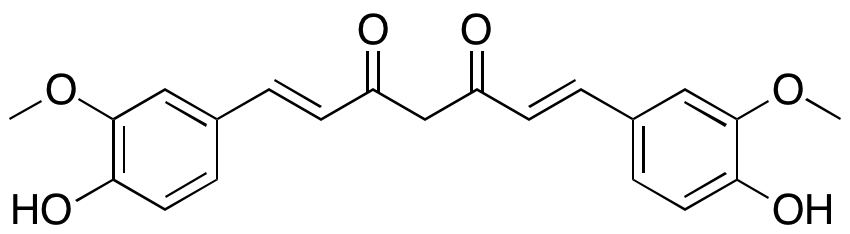
Curcumin, high purity

Curcumin, high purity

Product ID C8070
Cas No. 458-37-7
Purity ≥98%
Product Unit SizeCostQuantityStock
10 mg $133.00 In stock
25 mg $276.00 In stock
100 mg $715.00 In stock
Bulk Quote

Quicklinks

  • Description
  • Product Info
  • Shipping and Storage
  • Downloads
  • References
  • Description
  • Product Info
  • Shipping and Storage
  • Downloads
  • References
  • Custom Order

Description

Curcumin is an active component found in turmeric, a member of the ginger family. Curcumin displays a wide variety of health benefits, including antioxidative, anticancer chemotherapeutic, neuroprotective, antifungal, antibacterial, and anti-atherosclerotic activities. In an animal model of running-induced oxidative damage, curcumin decreases NADPH-oxidase mRNA and hydrogen peroxide levels, decreasing oxidative stress. Curcumin increases levels of APOBEC1, increasing beneficial ApoB-48 and decreasing harmful ApoB-100, facilitating increased clearance of lipid particles from plasma in vitro. In cellular models of cancer, curcumin activates mammalian sterile 20-like kinase 1 (MST1), activating JKN and inducing apoptosis. In cellular models of glioma, curcumin downregulates expression of Shh, Smo, GLI1, cyclin D1, and Bcl-2, inhibiting proliferation and migration and increasing apoptosis; in related animal models, curcumin decreases tumor volume and prolongs survival. In an animal model of Alzheimer’s disease utilizing the Morris water maze, curcumin rescues cognitive deficits by inhibiting collapsing response mediator protein 2 (CRMP2) and protecting against amyloid-β (Aβ)-induced hippocampal damage. This compound inhibits fMLP- and LPS-induced suppression of neutrophil apoptosis by preventing activation of NF-κB and decreasing production of pro-inflammatory mediators such as IL-6, IL-8, MIP-1α, and MIP-1β. Curcumin also displays antibacterial and antifungal activities, inhibiting cell wall biosynthesis of Candida albicans in vitro.

Product Info

Cas No.

458-37-7

Purity

≥98%

Formula

C21H20O6

Formula Wt.

368.38

Chemical Name

(1E,6E)-1,7-Bis(4-hydroxy-3-methoxyphenyl)-1,6-heptadiene-3,5-dione

IUPAC Name

(1E,6E)-1,7-bis(4-hydroxy-3-methoxyphenyl)hepta-1,6-diene-3,5-dione

Synonym

Turmeric yellow

Melting Point

183°C

Solubility

Insoluble in water. Soluble in ethanol, DMSO.

Appearance

Orange Powder

Shipping and Storage

Store Temp

Ambient

Ship Temp

Ambient

Downloads

MSDS

C8070 MSDS PDF

Info Sheet

C8070 Info Sheet PDF

Brochures

Curcumin Flyer

Natural Products Booklet

References

Kawanishi N, Kato K, Takahashi M, et al. Curcumin attenuates oxidative stress following downhill running-induced muscle damage. Biochem Biophys Res Commun. 2013 Oct 30. [Epub ahead of print]. PMID: 24184481.

Du WZ, Feng Y, Wang XF, et al. Curcumin Suppresses Malignant Glioma Cells Growth and Induces Apoptosis by Inhibition of SHH/GLI1 Signaling Pathway in Vitro and Vivo. CNS Neurosci Ther. 2013 Oct 25. [Epub ahead of print]. PMID: 24165291.

Tian N, Li X, Luo Y, et al. Curcumin regulates the metabolism of low density lipoproteins by improving the C-to-U RNA editing efficiency of apolipoprotein B in primary rat hepatocytes. Mol Med Rep. 2013 Oct 24. [Epub ahead of print]. PMID: 24173373.

Wang Y, Yin H, Li J, et al. Amelioration of β-amyloid-induced cognitive dysfunction and hippocampal axon degeneration by curcumin is associated with suppression of CRMP-2 hyperphosphorylation. Neurosci Lett. 2013 Oct 21. [Epub ahead of print]. PMID: 24157857.

Antoine F, Simard JC, Girard D. Curcumin inhibits agent-induced human neutrophil functions in vitro and lipopolysaccharide-induced neutrophilic infiltration in vivo. Int Immunopharmacol. 2013 Oct 21. [Epub ahead of print]. PMID: 24157330.

Gunes H, Gulen D, Mutlu R, et al. Antibacterial effects of curcumin: an in vitro minimum inhibitory concentration study. Toxicol Ind Health. 2013 Oct 21. [Epub ahead of print]. PMID: 24097361.

Kumar A, Dhamgaye S, Maurya IK, et al. Curcumin targets cell wall integrity via calcineurin mediated signaling in Candida albicans. Antimicrob Agents Chemother. 2013 Oct 21. [Epub ahead of print]. PMID: 24145527.

Yu T, Ji J, Guo YL. MST1 activation by curcumin mediates JNK activation, Foxo3a nuclear translocation and apoptosis in melanoma cells. Biochem Biophys Res Commun. 2013 Oct 14. [Epub ahead of print]. PMID: 24134840.

Narayanan N, Nargi D, Randolph C, et al. Liposome encapsulation of curcumin and resveratrol in combination reduces prostate cancer incidence in PTEN knockout mice. Int J Cancer. 2009Feb 6;125(1):1-8. PMID: 19326431.

Custom Order

  • Size of single unit expressed as number (e.g. '500' in the case of 500 mg)
  • Total quantity of unit size desired (e.g. '10' in the case of 10 x 500 mg). If only one unit is desired, you may leave this blank.
  • This field is for validation purposes and should be left unchanged.

Related Products

  • T2816

    L-Theanine

    Non-essential amino acid found in Camellia and ...

    ≥98%
  • P0013

    P7C3

    Aminopropyl carbazole, neuroprotective.

    ≥98%
  • C2916

    Chenodeoxycholic Acid

    Endogenous bile acid; FXR agonist.

    ≥98%
  • T165131

    Tedizolid

    Effective against gram-positive pathogens

    ≥98%
  • K977545

    Kynurenic acid

    Endogenous NMDA receptor antagonist.

    ≥99%
  • G0146

    Galanin, human

    Endogenous neuropeptide, involved in nociceptio...

    ≥98%
  • T286165

    Theaflavin-3-gallate

    Polyphenolic compound present in black tea.

    ≥95%
  • T3197

    L-Thyroxine Sodium Pentahydrate

    Endogenous thyroid hormone T4.

    ≥97%
  • G4480

    Glucagon, human

    Endogenous peptide hormone, counteracts insulin...

    ≥95%
  • C1627

    Cefaclor Monohydrate

    β-lactam cephalosporin; penicillin binding pro...

    ≥97%
  • M5746

    Molsidomine

    NO donor; annexin A2 inhibitor.

    ≥98%
  • U682042

    URB602

    Inhibitor of Monoacyglycerol lipase (MAGL).

    ≥98%
  • T8020

    Tuftsin

    Tetrapeptide, IgG Fc region derivative; Nrp1 ag...

    ≥95%
  • A4544

    Allyl Disulfide

    Organosulfur found in garlic.

    ≥98%
  • A7672

    Atropine Sulfate Monohydrate

    Tropane alkaloid found in Solanaceae plants; mA...

    ≥98%
  • T0116

    2″,3″-Dihydrocephalomannine

    Cephalomannine derivative found in Taxus; poten...

    ≥96%
  • T6817

    D(+)-Trehalose Dihydrate

    α-Linked disaccharide composed of α-glucose u...

    ≥98%
  • N5652

    Nonactin

    Naturally-ocurring neurtral cyclic ionophore, m...

    ≥95%, TLC
  • O9596

    Oxybutynin Hydrochloride

    mAChR antagonist.

    ≥98%
  • G8101

    Guaifenesin

    Expectorant.

    ≥98%

Footer

  • Contact Us
  • About Us
  • Site Map
  • Terms and Conditions
LKT Laboratories, Inc.
545 Phalen Blvd.
St. Paul MN, 55130

Ph: (888)-558-5227
Fax: (888)-558-7329

©2026 LKT Laboratories, All Rights Reserved - Products for research use only