• Skip to primary navigation
  • Skip to main content
  • Skip to footer

LKT Labs

Biochemicals for Life Science Research

  • Products
    • New Products
    • Cancer Biology
    • Cardiovascular
    • Endocrine Signaling and Immunology
    • Metabolic and GI Pathology
    • Microbiology
    • Natural Products
    • Neuroscience
    • Peptides
    • Pharmaceutical Impurities and Derivatives
    • Stem Cell Modulators
  • Services
    • Custom Synthesis
    • Natural Product Isolation
    • Analytical Services
  • Int’l Distributors
  • Support
    • About LKT Labs
    • General Inquiry
    • Bulk Quote Request
    • Document Request
    • Technical Support
    • Catalog Request
    • Product Flyers
  • Contact Us
  • Cart
  • Login / Register
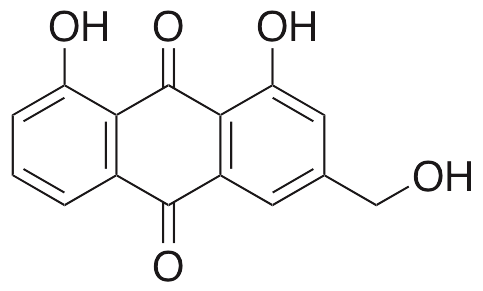
Aloe Emodin

Aloe Emodin

Product ID A4617
Cas No. 481-72-1
Purity ≥98%
Product Unit SizeCostQuantityStock
25 mg $72.00 In stock
100 mg $204.00 In stock
250 mg $357.00 In stock
Bulk Quote

Quicklinks

  • Description
  • Product Info
  • Shipping and Storage
  • Downloads
  • References
  • Description
  • Product Info
  • Shipping and Storage
  • Downloads
  • References
  • Custom Order

Description

Aloe emodin is an anthraquinone found in the aloe plant. Aloe emodin is most commonly known for its stimulant-laxative action, but also shows antioxidative, anticancer chemotherapeutic, and anti-angiogenic activity. This compound activates CFTR Cl- channels in the colon, potentially increasing fluid secretion and resulting in laxative activity. Aloe emodin acts on a number of targets in cellular models of cancer, including p65lck, ERα, NF-κB, and mTORC2. Additionally, aloe emodin induces apoptosis in glioma models through disruption of the mitochondria membrane potential.

Product Info

Cas No.

481-72-1

Purity

≥98%

Formula

C15H10O5

Formula Wt.

270.24

Chemical Name

1,8-Dihydroxy-3-(hydroxymethyl)-9,10-anthracenedione

IUPAC Name

1,8-dihydroxy-3-(hydroxymethyl)anthracene-9,10-dione

Melting Point

223-224°C

Solubility

Soluble in water (partly), hot alcohol, methanol, chloroform, and DMSO (50 mg/ml)

Appearance

Yellow-orange powder

Shipping and Storage

Store Temp

-20°C

Ship Temp

Ambient

Downloads

MSDS

A4617 MSDS PDF

Info Sheet

A4617 Info Sheet PDF

Brochures

PI3K-Akt-mTORC Pathway Booklet

References

Ismail S, Haris K, Abdul Ghani AR, et al. Enhanced induction of cell cycle arrest and apoptosis via the mitochondrial membrane potential disruption in human U87 malignant glioma cells by aloe emodin. J Asian Nat Prod Res. 2013 Jul 22. [Epub ahead of print]. PMID: 23869465.

Huang PH, Huang CY, Chen MC, et al. Emodin and Aloe-Emodin Suppress Breast Cancer Cell Proliferation through ER α Inhibition. Evid Based Complement Alternat Med. 2013; Epub 2013 Jun 24. PMID: 23864887.

Zhang W, Chen H, Liu DL, et al. Emodin sensitizes the gemcitabine-resistant cell line Bxpc-3/Gem to gemcitabine via downregulation of NF-κB and its regulated targets. Int J Oncol. 2013 Apr;42(4):1189-96. PMID: 23440366.

Liu K, Park C, Li S, et al. Aloe-emodin suppresses prostate cancer by targeting the mTOR complex 2. Carcinogenesis. 2012 Jul;33(7):1406-11. PMID: 22532249.

Yang H, Xu LN, He CY, et al. CFTR chloride channel as a molecular target of anthraquinone compounds in herbal laxatives. Acta Pharmacol Sin. 2011 Jun;32(6):834-9. PMID: 21602836.

Srinivas G, Babykutty S, Sathiadevan PP, et al. Molecular mechanism of emodin action: transition from laxative ingredient to an antitumor agent. Med Res Rev. 2007 Sep;27(5):591-608. PMID: 17019678.

Custom Order

  • Size of single unit expressed as number (e.g. '500' in the case of 500 mg)
  • Total quantity of unit size desired (e.g. '10' in the case of 10 x 500 mg). If only one unit is desired, you may leave this blank.
  • This field is for validation purposes and should be left unchanged.

Related Products

  • M9367

    Myricetin

    Flavonol found in fruits and vegetables; COMT i...

    ≥98%
  • M1565

    S-Methyl-L-cysteine-S-oxide

    Organosulfur found in cruciferous vegetables; a...

    ≥95%
  • A6971

    ARRY-162

    MEK1/2 and ERK inhibitor.

    ≥99%
  • U451349

    Ulixertinib

    May induce apoptosis in lymphoma cell lines.

    ≥98%
  • E9416

    Exendin-3

    Peptide, GLP-1 analog found in Heloderma; GLP-1...

    ≥95%
  • P0255

    Pantoprazole

    H+/K+ ATPase and ROCK-2 inhibitor.

    ≥98%
  • L1785

    Levofloxacin Hemihydrate

    Fluoroquinolone, S-(-) isomer of ofloxacin; top...

    ≥98%
  • G3554

    Ginsenoside Rb3

    Triterpene saponin found in species of Panax.

    ≥98%
  • A5039

    Amitraz

    Insecticide; α-adrenergic agonist, MAO inhibit...

    ≥97%
  • G4535

    Glimepiride

    Sulfonylurea; ATP-sensitive K+ channel blocker....

    ≥98%
  • T1010

    7-Acetyl Paclitaxel

    Synthesis impurity

    ≥98%
  • N1868

    Neratinib

    EGFR inhibitor.

    ≥98%
  • L8010

    D-Luciferin Potassium

    Heterocyclic light-emitting compound, natural l...

    ≥98%
  • C1609

    Cecropin B

    Antimicrobial peptide found in Hyalophora cecro...

    ≥95%
  • T564093

    (+)-δ-Tocopherol

    Vitamin E component

    ≥98%
  • E5200

    Enalaprilat Dihydrate

    Enalapril metabolite; ACE inhibitor.

    ≥98%
  • H9614

    Hydrochlorothiazide

    Thiazide diuretic; NCCT inhibitor, carbonic anh...

    ≥98%
  • M1877

    Methylprednisolone

    Synthetic steroid; glucocorticoid agonist.

    ≥96%
  • Z161022

    α-Zearalanol

    Mycotoxin that has structural similarity to est...

    ≥98%
  • C8500

    CV-65

    1,8-Diaza-anthracene-tetrone; JNK and ERK5 inhi...

    ≥70%

Footer

  • Contact Us
  • About Us
  • Site Map
  • Terms and Conditions
LKT Laboratories, Inc.
545 Phalen Blvd.
St. Paul MN, 55130

Ph: (888)-558-5227
Fax: (888)-558-7329

©2026 LKT Laboratories, All Rights Reserved - Products for research use only