Description
PF-06447475 inhibits leucine-rich repeat kinase 2 (LRRK2), exhibiting neuroprotective activity. In animal models of Parkinson’s disease, this compound suppresses neuroinflammation and neurodegeneration.
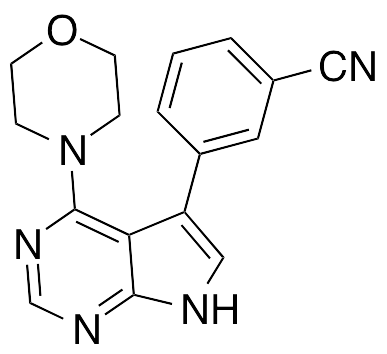
| Product Unit Size | Cost | Quantity | Stock |
|---|
PF-06447475 inhibits leucine-rich repeat kinase 2 (LRRK2), exhibiting neuroprotective activity. In animal models of Parkinson’s disease, this compound suppresses neuroinflammation and neurodegeneration.
| Cas No. | 1527473-33-1 |
|---|---|
| Purity | ≥98% |
| Formula | C17H15N5O |
| Formula Wt. | 305.13 |
| Chemical Name | 3-[4-(4-Morpholinyl)-7H-pyrrolo[2,3-d]pyrimidin-5-yl]benzonitrile |
| IUPAC Name | 3-[4-(4-Morpholinyl)-7H-pyrrolo[2,3-d]pyrimidin-5-yl]benzonitrile |
| Solubility | DMSO 61 mg/mL Water Insoluble Ethanol Insoluble |
| Store Temp | -20°C |
|---|---|
| Ship Temp | Ambient |
| MSDS | |
|---|---|
| Info Sheet | |
| Brochures |
Daher JP, Abdelmotilib HA, Hu X, et al. LRRK2 Pharmacological Inhibition Abates α-Synuclein Induced Neurodegeneration. J Biol Chem. 2015 Jun 15. [Epub ahead of print]. PMID: 26078453.
Henderson JL, Kormos BL, Hayward MM, et al. Discovery and preclinical profiling of 3-[4-(morpholin-4-yl)-7H-pyrrolo[2,3-d]pyrimidin-5-yl]benzonitrile (PF-06447475), a highly potent, selective, brain penetrant, and in vivo active LRRK2 kinase inhibitor. J Med Chem. 2015 Jan 8;58(1):419-32. PMID: 25353650.