• Skip to primary navigation
  • Skip to main content
  • Skip to footer

LKT Labs

Biochemicals for Life Science Research

  • Products
    • New Products
    • Cancer Biology
    • Cardiovascular
    • Endocrine Signaling and Immunology
    • Metabolic and GI Pathology
    • Microbiology
    • Natural Products
    • Neuroscience
    • Peptides
    • Pharmaceutical Impurities and Derivatives
    • Stem Cell Modulators
  • Services
    • Custom Synthesis
    • Natural Product Isolation
    • Analytical Services
  • Int’l Distributors
  • Support
    • About LKT Labs
    • General Inquiry
    • Bulk Quote Request
    • Document Request
    • Technical Support
    • Catalog Request
    • Product Flyers
  • Contact Us
  • Cart
  • Login / Register
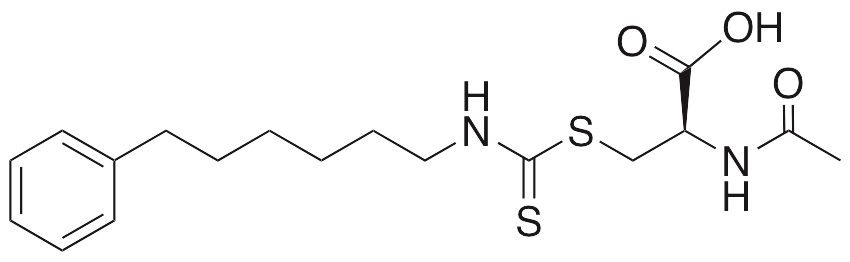
N-Acetyl-S-(N′-phenylhexylthiocarbamoyl)-L-cysteine

N-Acetyl-S-(N′-phenylhexylthiocarbamoyl)-L-cysteine

Product ID A0902
Cas No.
Purity ≥98%
Product Unit SizeCostQuantityStock
10 mg $214.00 In stock
25 mg $465.00 In stock
100 mg $1,459.00 In stock
Bulk Quote

Quicklinks

  • Description
  • Product Info
  • Shipping and Storage
  • Downloads
  • References
  • Description
  • Product Info
  • Shipping and Storage
  • Downloads
  • References
  • Custom Order

Description

N-Acetyl-S-(N’-phenylhexylthiocarbamoyl)-L-cysteine (PHITC) is a cysteine conjugate of N-acetyl-phenylhexylisothiocyanate. Isothiocyanates are typically found in plants of the Brassicaceae family, including broccoli, cabbage, and radish. Isothiocyanates are best known for their antioxidative, anticancer chemotherapeutic, chemopreventive, anti-angiogenic, and antibiotic properties. In vitro, PHITC increases caspase 3 activity and cleavage of poly(ADP)-ribose polymerase (PARP), inducing caspase-mediated apoptosis in cellular models. This compound decreases oxidation of carcinogen NNK and increases activity of NADPH:quinone oxidoreductase and glutathione-S-transferase in vitro and in vivo. PHITC inhibits histone deacetylase (HDAC) activity, IL-6 receptor production, and VEGF expression; it also induces mitochondrial membrane depolarization and apoptosis in myeloma cells. In leukemia cells, PHITC inhibits expression of cyclin and increases expression of CDK inhibitors, inducing apoptosis and inhibiting growth of xenografts of these cells in animals.

Product Info

Purity

≥98%

Formula

C18H26N2O3S2

Formula Wt.

382.54

Chemical Name

N-Acetyl-S-(N′-phenylhexylthiocarbamoyl)-L-cysteine

Synonym

Acetyl phenylhexylisothiocyanate -L-cysteine

Appearance

White to off white powder

Shipping and Storage

Store Temp

-20°C

Ship Temp

Ambient

Downloads

MSDS

A0902 MSDS PDF

Info Sheet

A0902 Info Sheet PDF

References

Lu Q, Lin X, Feng J, et al. Phenylhexyl isothiocyanate has dual function as histone deacetylase inhibitor and hypomethylating agent and can inhibit myeloma cell growth by targeting critical pathways. J Hematol Oncol. 2008 Jun 9;1:6. PMID: 18577263.

Lu L, Liu D, Ma X, et al. The phenylhexyl isothiocyanate induces apoptosis and inhibits leukemia cell growth in vivo. Oncol Rep. 2006 Dec;16(6):1363-7. PMID: 17089062.

Morse MA, Eklind KI, Hecht SS, et al. Structure-activity relationships for inhibition of 4-(methylnitrosamino)-1-(3-pyridyl)-1-butanone lung tumorigenesis by arylalkyl isothiocyanates in A/J mice. Cancer Res. 1991 Apr 1;51(7):1846-50. PMID: 2004368.

Custom Order

  • Size of single unit expressed as number (e.g. '500' in the case of 500 mg)
  • Total quantity of unit size desired (e.g. '10' in the case of 10 x 500 mg). If only one unit is desired, you may leave this blank.
  • This field is for validation purposes and should be left unchanged.

Related Products

  • I5440

    INK128

    mTOR inhibitor.

    ≥99%
  • B6856

    5-Bromo-2′-Deoxyuridine

    Nucleoside (thymidine) analog.

    ≥98%
  • M1680

    5-Methoxyindole

    Core structure of melatonin; potential PPARγ a...

    ≥98%
  • D3300

    (Z)-1,-Bis(2-methoxy-5-(trifluoromethyl)phenyl)diazene oxide

    Azoxy compound

    ≥98%
  • A9708

    AZD-1208

    Pim-1 inhibitor.

    ≥98%
  • X4402

    XL-147

    Dual inhibitor of PI3K and mTOR.

    ≥98%
  • Z160021

    Zearalanone

    Mycotoxin.

    ≥97%
  • M400220

    MK-2206 Dihydrochloride

    Akt inhibitor.

    ≥99%
  • M4452

    MLN2480

    Raf inhibitor.

    ≥98%
  • I544766

    Intepirdine

    Selective 5-HT6 receptor antagonist

    ≥98%
  • M5877

    Motesanib Diphosphate

    VEGFR, PDGFR, c-Kit, RET inhibitor.

    ≥98%
  • Z0222

    Zafirlukast

    VEGF-C/Nrp2 inhibitor. Leukotriene receptor ant...

    ≥98%
  • C2970

    Chrysophanol

    Anthraquinone found in Rheum.

    ≥98%
  • C1629

    Cefoperazone Acid

    β-lactam cephalosporin; penicillin binding pro...

    ≥98%
  • A4497

    Alyssin Sulfone

    Naturally sourced ITC, sulfonyl analog of sulfo...

    ≥97%
  • C4659

    Clobetasol Propionate

    Corticosteroid; glucocorticoid agonist.

    ≥98%
  • U451349

    Ulixertinib

    May induce apoptosis in lymphoma cell lines.

    ≥98%
  • V3277

    Vitamin E

    Synthetic vitamin E, antioxidant.

    ≥98%
  • C1867

    Ceramide

    Endogenous sphingosine-based lipid, component o...

    ≥98%
  • F4782

    Fludarabine Phosphate

    Nucleoside (adenosine) analog; DNA chain termin...

    ≥98%

Footer

  • Contact Us
  • About Us
  • Site Map
  • Terms and Conditions
LKT Laboratories, Inc.
545 Phalen Blvd.
St. Paul MN, 55130

Ph: (888)-558-5227
Fax: (888)-558-7329

©2026 LKT Laboratories, All Rights Reserved - Products for research use only