• Skip to primary navigation
  • Skip to main content
  • Skip to footer

LKT Labs

Biochemicals for Life Science Research

  • Products
    • New Products
    • Cancer Biology
    • Cardiovascular
    • Endocrine Signaling and Immunology
    • Metabolic and GI Pathology
    • Microbiology
    • Natural Products
    • Neuroscience
    • Peptides
    • Pharmaceutical Impurities and Derivatives
    • Stem Cell Modulators
  • Services
    • Custom Synthesis
    • Natural Product Isolation
    • Analytical Services
  • Int’l Distributors
  • Support
    • About LKT Labs
    • General Inquiry
    • Bulk Quote Request
    • Document Request
    • Technical Support
    • Catalog Request
    • Product Flyers
  • Contact Us
  • Cart
  • Login / Register
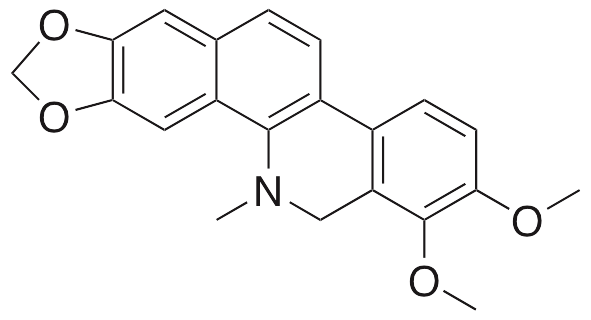
Dihydrochelerythrine

Dihydrochelerythrine

Product ID D3428
Cas No. 6880-91-7
Purity ≥98%
Product Unit SizeCostQuantityStock
1 mg $64.00 In stock
5 mg $155.00 In stock
25 mg $584.00 In stock
Bulk Quote

Quicklinks

  • Description
  • Product Info
  • Shipping and Storage
  • Downloads
  • References
  • Description
  • Product Info
  • Shipping and Storage
  • Downloads
  • References
  • Custom Order

Description

Dihydrochelerythrine (DHC) is a benzophenanthridine alkaloid originally found in the stem bark of Garcinia. This compound exhibits a wide variety of antimicrobial activities (anti-parasitic, antifungal, and antibacterial) as well as anticancer, analgesic, and anti-inflammatory properties. DHC is active against Trypanosoma, Leishmania, Botrytis, Erysiphe, Candida, and various gram positive and gram negative bacteria. Additionally, DHC induces dissipation of the mitochondrial membrane potential in leukemia cells, resulting in apoptosis and necrosis. This compound also binds DNA sequences containing contiguous G or C base pairs.

Product Info

Cas No.

6880-91-7

Purity

≥98%

Formula

C21H19NO4

Formula Wt.

349.38

IUPAC Name

1,2-dimethoxy-12-methyl-13H-[1,3]benzodioxolo[5,6-c]phenanthridine

Solubility

10mM in DMSO 10mM in water

Appearance

White to off white powder

Shipping and Storage

Store Temp

4°C

Ship Temp

Ambient

Downloads

MSDS

D3428 MSDS PDF

Info Sheet

D3428 Info Sheet PDF

References

Yao JY, Zhou ZM, Li XL, et al. Antiparasitic efficacy of dihydrosanguinarine and dihydrochelerythrine from Macleaya microcarpa against Ichthyophthirius multifiliis in richadsin (Squaliobarbus curriculus). Vet Parasitol. 2011 Dec 29;183(1-2):8-13. PMID: 21813242.

Feng G, Zhang J, Liu YQ. Inhibitory activity of dihydrosanguinarine and dihydrochelerythrine against phytopathogenic fungi. Nat Prod Res. 2011 Jul;25(11):1082-9. PMID: 21500094.

Vrba J, Dolezel P, Vicar J, et al. Chelerythrine and dihydrochelerythrine induce G1 phase arrest and bimodal cell death in human leukemia HL-60 cells. Toxicol In Vitro. 2008 Jun;22(4):1008-17. PMID: 18358694.

Fotie J, Bohle DS, Olivier M, et al. Trypanocidal and antileishmanial dihydrochelerythrine derivatives from Garcinia lucida. J Nat Prod. 2007 Oct;70(10):1650-3. PMID: 17880175.

Hu J, Zhang WD, Liu RH, et al. Benzophenanthridine alkaloids from Zanthoxylum nitidum (Roxb.) DC, and their analgesic and anti-inflammatory activities. Chem Biodivers. 2006 Sep;3(9):990-5. PMID: 17193331.

Bai LP, Zhao ZZ, Cai Z, et al. DNA-binding affinities and sequence selectivity of quaternary benzophenanthridine alkaloids sanguinarine, chelerythrine, and nitidine. Bioorg Med Chem. 2006 Aug 15;14(16):5439-45. PMID: 16730995.

Navarro V, Delgado G. Two antimicrobial alkaloids from Bocconia arborea. J Ethnopharmacol. 1999 Aug;66(2):223-6. PMID: 10433482.

Custom Order

  • Size of single unit expressed as number (e.g. '500' in the case of 500 mg)
  • Total quantity of unit size desired (e.g. '10' in the case of 10 x 500 mg). If only one unit is desired, you may leave this blank.
  • This field is for validation purposes and should be left unchanged.

Related Products

  • E0073

    Ebselen

    Synthetic glutathione peroxidase mimetic; yeast...

    ≥99%
  • P0010

    Pituitary Adenylate Cyclase-activating Polypeptide-related Peptide, human

    Peptide, involved in paracrine and autocrine ce...

    ≥95%
  • R0349

    Ramosetron

    5-HT3 antagonist.

    ≥99%
  • W0269

    (±)-Warfarin

    Coumarin; VKORC1 inhibitor.

    ≥98%
  • M964098

    Mycophenolate Mofetil

    Prodrug of the compound mycophenolic acid.

    ≥98%
  • S3470

    Sirtinol

    Sirtuin inhibitor and iron chelator.

    ≥98%
  • S680017

    SR-717 Lithium Salt

    STING agonist

    ≥98%
  • Z5745

    Zolmitriptan

    5-HT1B/1D agonist.

    ≥99%
  • M568268

    Mogroside IV

    Triterpenoid

    ≥98%
  • T165131

    Tedizolid

    Effective against gram-positive pathogens

    ≥98%
  • E9819

    Ezetimibe

    NPC1L1 inhibitor.

    ≥99%
  • T9970

    Tyrphostin AG1295

    PDGFR inhibitor.

    ≥98%
  • I4800

    Imatinib free base

    Inhibitor of Abl, c-Kit, and PDGFR.

    ≥99%
  • SC7056

    Snake venom – Crotalus durissus terrificus

    Snake venom found in Crotalus durrisus terrific...

    ≥98%
  • A5278

    Angiotensin III, human

    Endogenous peptide, cleavage product of AT II; ...

    ≥95%
  • L2876

    Luteinizing Hormone Releasing Hormone III, lamprey

    Peptide hormone found in eels; GnRH agonist, we...

    ≥98%
  • N1757

    Neostigmine Bromide

    AChE inhibitor.

    ≥92%
  • A4498

    Alytesin

    Antimicrobial peptide found in amphibians.

    ≥95%
  • D3215

    Didymin

    Flavonoid glycoside found in citrus fruit.

    ≥98%
  • F5745

    Folic Acid

    Non-endogenous essential vitamin (B9), found in...

    ≥96%

Footer

  • Contact Us
  • About Us
  • Site Map
  • Terms and Conditions
LKT Laboratories, Inc.
545 Phalen Blvd.
St. Paul MN, 55130

Ph: (888)-558-5227
Fax: (888)-558-7329

©2026 LKT Laboratories, All Rights Reserved - Products for research use only