• Skip to primary navigation
  • Skip to main content
  • Skip to footer

LKT Labs

Biochemicals for Life Science Research

  • Products
    • New Products
    • Cancer Biology
    • Cardiovascular
    • Endocrine Signaling and Immunology
    • Metabolic and GI Pathology
    • Microbiology
    • Natural Products
    • Neuroscience
    • Peptides
    • Pharmaceutical Impurities and Derivatives
    • Stem Cell Modulators
  • Services
    • Custom Synthesis
    • Natural Product Isolation
    • Analytical Services
  • Int’l Distributors
  • Support
    • About LKT Labs
    • General Inquiry
    • Bulk Quote Request
    • Document Request
    • Technical Support
    • Catalog Request
    • Product Flyers
  • Contact Us
  • Cart
  • Login / Register
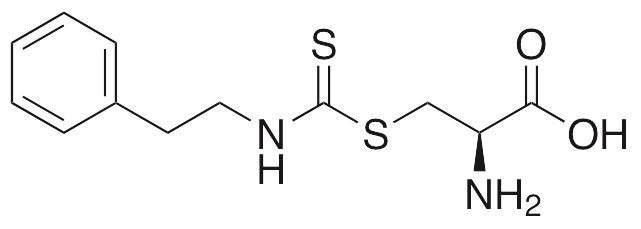
S-(N-Phenethylthiocarbamoyl)-L-cysteine

S-(N-Phenethylthiocarbamoyl)-L-cysteine

Product ID P2512
Cas No.
Purity ≥98%
Product Unit SizeCostQuantityStock
10 mg $113.00 In stock
25 mg $201.00 In stock
100 mg $616.00 In stock
Bulk Quote

Quicklinks

  • Description
  • Product Info
  • Shipping and Storage
  • Downloads
  • References
  • Description
  • Product Info
  • Shipping and Storage
  • Downloads
  • References
  • Custom Order

Description

S-(N-Phenethylthiocarbamoyl)-L-cysteine is a conjugate of a phenethylisothiocyanate (PEITC) compound and cysteine. Isothiocyanates are typically found in plants of the Brassicaceae family, including broccoli, cabbage, and radish. Isothiocyanates are best known for their antioxidative, anticancer chemotherapeutic, chemopreventive, anti-angiogenic, and antibiotic properties. In vitro, PEITC increases caspase 3 activity and cleavage of poly(ADP)-ribose polymerase (PARP), inducing caspase-mediated apoptosis in Jurkat T cells and other cellular models. PEITC increases activation of JNK1, one potential mechanism behind its regulation of phase II detoxifying enzyme gene expression. Additionally, PEITC decreases levels of Bcl-xl and increases levels of Bax, also decreasing the mitochondrial membrane potential and inducing intracellular influx of free Ca2+, resulting in cell death. This compound decreases oxidation of carcinogen NNK and increases activity of NADPH:quinone oxidoreductase and glutathione-S-transferase in vitro and in vivo. In glioma cells, PEITC alters PI3K/MAPK signaling to inhibit accumulation of HIF-1α and secretion of VEGF during hypoxia.

Product Info

Purity

≥98%

Formula

C12H16N2O2S2

Formula Wt.

284.40

Chemical Name

S-(N-Phenethylthiocarbamoyl)-L-cysteine

Synonym

Phenethylisothiocyanate-L-cysteine

Appearance

White to off white powder

Shipping and Storage

Store Temp

-20°C

Ship Temp

Ambient

Downloads

MSDS

P2512 MSDS PDF

Info Sheet

P2512 Info Sheet PDF

References

Tusskorn O, Senggunprai L, Prawan A, et al Phenethyl isothiocyanate induces calcium mobilization and mitochondrial cell death pathway in cholangiocarcinoma KKU-M214 cells. BMC Cancer. 2013 Dec 5;13(1):571. PMID: 24304591.

Stan SD, Singh SV, Whitcomb DC, et al. Phenethyl Isothiocyanate Inhibits Proliferation and Induces Apoptosis in Pancreatic Cancer Cells In Vitro and in a MIAPaca2 Xenograft Animal Model. Nutr Cancer. 2013 Nov 6. [Epub ahead of print]. PMID: 24195616.

Gupta B, Chiang L, Chae K, et al. Phenethyl isothiocyanate inhibits hypoxia-induced accumulation of HIF-1α and VEGF expression in human glioma cells. Food Chem. 2013 Dec 1;141(3):1841-6. PMID: 23870899.

Thomson SJ, Brown KK, Pullar JM, et al. Phenethyl isothiocyanate triggers apoptosis in Jurkat cells made resistant by the overexpression of Bcl-2. Cancer Res. 2006 Jul 1;66(13):6772-7. PMID: 16818653.

Yu R, Mandlekar S, Harvey KJ, et al. Chemopreventive isothiocyanates induce apoptosis and caspase-3-like protease activity. Cancer Res. 1998 Feb 1;58(3):402-8. PMID: 9458080.

Yu R, Jiao JJ, Duh JL, et al. Phenethyl isothiocyanate, a natural chemopreventive agent, activates c-Jun N-terminal kinase 1. Cancer Res. 1996 Jul 1;56(13):2954-9. PMID: 8674048.

Guo Z, Smith TJ, Wang E, et al. Structure-activity relationships of arylalkyl isothiocyanates for the inhibition of 4-(methylnitrosamino)-1-(3-pyridyl)-1-butanone metabolism and the modulation of xenobiotic-metabolizing enzymes in rats and mice. Carcinogenesis. 1993 Jun;14(6):1167-73. PMID: 8508504.

Custom Order

  • Size of single unit expressed as number (e.g. '500' in the case of 500 mg)
  • Total quantity of unit size desired (e.g. '10' in the case of 10 x 500 mg). If only one unit is desired, you may leave this blank.
  • This field is for validation purposes and should be left unchanged.

Related Products

  • S0500

    SB-203580

    p38 MAPK inhibitor.

    ≥98%
  • A4438

    Allatostatin I

    Neuropeptide found in insects; juvenile hormone...

    ≥95%
  • I7870

    Itraconazole

    Triazole; 14-α demethylase inhibitor, Smo modu...

    ≥98%
  • D5709

    Docetaxel

    Semi-synthetic analog of taxol; microtubule dep...

    ≥98%
  • D3356

    Diosmetin

    O-methylated flavone found in vetch and various...

    ≥98%
  • M1613

    Medroxyprogesterone 17-Acetate

    Synthetic steroid used in HRT; PR, AR, glucocor...

    ≥99%
  • V3455

    Vinpocetine

    Targets nuclear factor kappa B activation.

    ≥98%
  • P1854

    Penicillic Acid

    Neuroactive mycotoxin produced by Penicillum an...

    ≥98%
  • P0244

    Palbociclib Hydrochloride

    CDK4/6 inhibitor.

    ≥99%
  • T5060

    TMP-269

    HDAC inhibitor.

    ≥98%
  • B5728

    Bohemine

    Purine derivative; CDK inhibitor.

    ≥98%
  • A0977

    Actinomycin

    Polypeptide antibiotic produced from Streptomyc...

    ≥98%
  • F4481

    Flurbiprofen

    NSAID; COX-1/2 inhibitor.

    ≥98%
  • B177550

    Benzbromarone

    Non-competitive inhibitor of xanthine oxidase.<...

    ≥99%
  • D6957

    Droloxifene

    Triphenylthylene, tamoxifen analog; SERM.

    ≥98%
  • C0016

    Caerulomycin A

    Bipyridamine toxin.

    ≥96%
  • A9435

    Axitinib

    VEGFR inhibitor.

    ≥98%
  • F6803

    FRAX486

    PAK inhibitor.Smo inhibitor.

    ≥98%
  • P200000

    PF-3845

    FAAH inhibitor.

    ≥98%
  • A9812

    AZD-1480

    JAK1/2 inhibitor.

    ≥98%

Footer

  • Contact Us
  • About Us
  • Site Map
  • Terms and Conditions
LKT Laboratories, Inc.
545 Phalen Blvd.
St. Paul MN, 55130

Ph: (888)-558-5227
Fax: (888)-558-7329

©2026 LKT Laboratories, All Rights Reserved - Products for research use only